


Fan-Out Queries in B2B AI Search

Fan-out queries are a core pattern in how AI search engines actually work. When you type a question into ChatGPT, Perplexity, or Gemini, the model does not look up a single source and stop. It fans out across multiple retrieval paths simultaneously, pulls relevant fragments, and synthesises them into a single answer. Understanding this process matters for any B2B company that wants its content to show up in those answers.
What fan-out queries are in AI search
In the context of AI search, a fan-out query is what happens when a model receives a complex question and breaks it into multiple parallel sub-queries to gather grounding information. Each sub-query targets a different angle of the question. The results come back in parallel, and the model synthesises them into one coherent response.
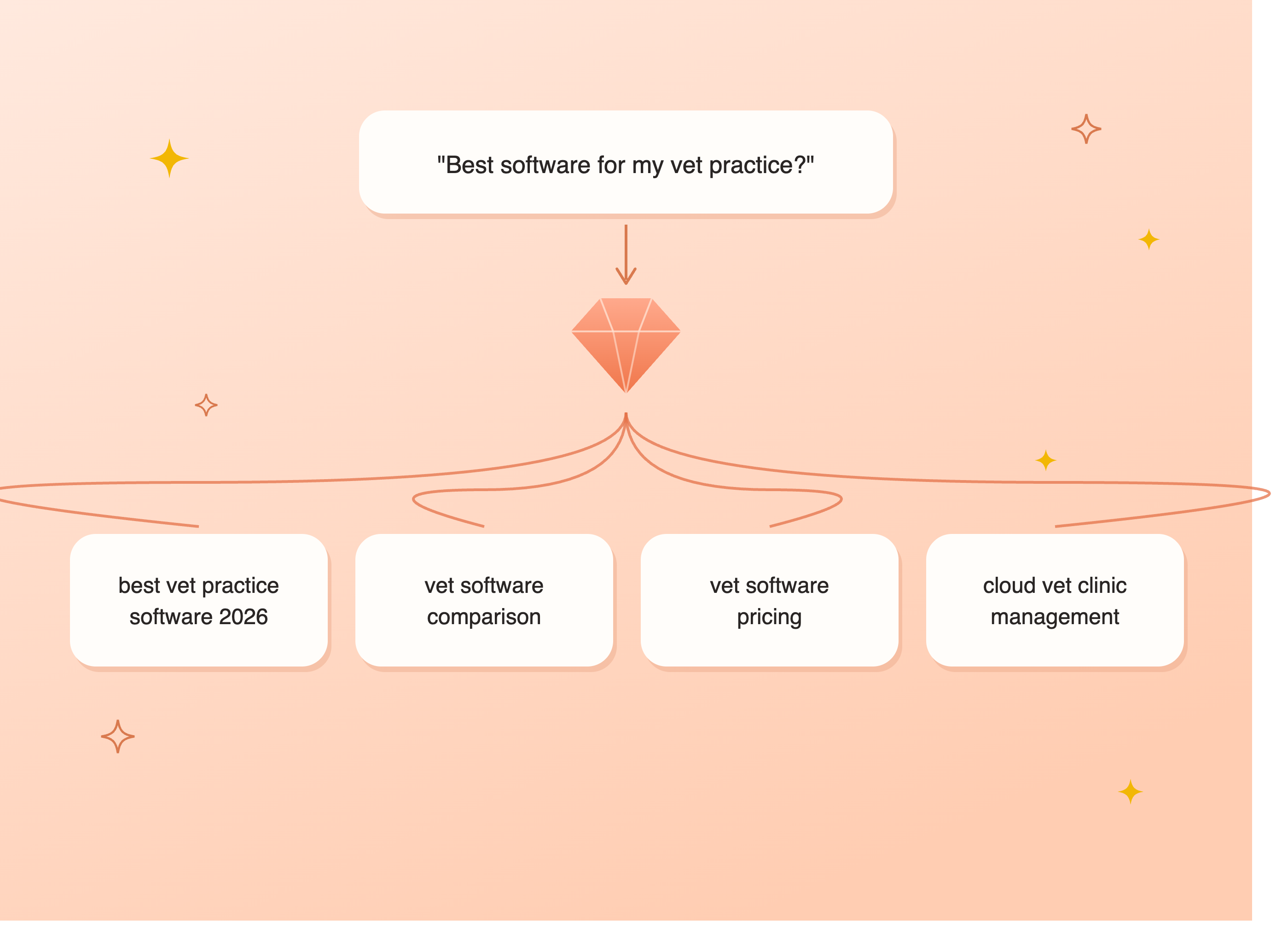
This is different from a simple keyword lookup. A user asking "what is the best way to handle multi-tenant data in a B2B SaaS product" is not sending one query to one source. The AI is effectively running several searches at once: looking for architectural patterns, for specific product comparisons, for practitioner opinions, and for recent technical writing on the topic. The answer you see is a merge of all of those.
Research published in How AI Platforms Search: Fan-Out Query Behavior Across Intent Types, Verticals, and Platforms puts concrete numbers on this behaviour: ChatGPT injects entities from training data on 32% of fan-out queries, Gemini casts a wide net with 27% expansion queries, and Perplexity leads in evidence-seeking at 21%. Each platform fans out differently, which has real implications for where your content needs to be and how it needs to be structured.
Why B2B content gets skipped by AI search
Most B2B content fails to get cited in AI search for a simple reason: it is written for keyword rankings, not for retrieval. AI models retrieve content that directly answers a specific question. If your page is a 2,000-word overview that buries the actual answer in paragraph seven, the model will skip it in favour of a page that leads with the answer.
The fan-out behaviour makes this worse. Because AI models are pulling from multiple sources simultaneously, they will pick the clearest, most direct answer from each source they retrieve. If your competitor's page answers "how does fan-out querying work in AI search" in the first paragraph and yours does not answer it at all, your competitor gets cited and you do not. This is not a link authority problem. It is a content structure problem.
89% of practitioners name AI and machine learning for the digital customer experience as a top trend for the next three to five years. The buyers you are trying to reach are already using AI search to research products and make decisions. If your content is not being retrieved and synthesised, you are invisible to a large and growing share of your market.
How AI models decide what to retrieve
When an AI model fans out across retrieval sources, it is looking for content that matches the intent of each sub-query it has generated. Intent here is specific: a model running an evidence-seeking sub-query wants a clear factual claim it can lift and cite. A model running an expansion sub-query wants context that helps it explain a concept. A model injecting entities from training data wants consistent, reliable naming that matches what it already knows about a topic.
This means the same piece of content can be retrieved for different reasons by different platforms. Perplexity, which leads in evidence-seeking behaviour, will favour content with specific, verifiable claims. Gemini, which tends to cast a wide net, will favour content that covers a topic with enough breadth to fill in contextual gaps. ChatGPT, which frequently injects training data entities, will favour content that uses consistent terminology matching established concepts.
Writing for all three means writing content that is specific enough to serve as evidence, broad enough to provide context, and consistent enough in its terminology to match what models already know.
What this means for how you write technical B2B content
The practical implication is that technical B2B content needs to be written so that individual paragraphs can stand alone as answers. A model retrieving a fragment of your page to answer a specific sub-query will not include the surrounding context. The fragment has to make sense on its own.
This is a real change from how most B2B content is written. Blog posts are typically written as narratives where each section builds on the last. That structure works for a human reader who starts at the top and reads down. It does not work well for AI retrieval, where a model might pull a single paragraph and nothing else.
A few things help:
- Lead each section with the answer, then explain it. Do not build to the answer.
- Use consistent terminology. If you call something a "fan-out query" in paragraph one, do not switch to "parallel retrieval" in paragraph four. Consistent naming tells the model you are still describing the same concept.
- Make factual claims specific. "AI models fan out across multiple sources" is weaker than "ChatGPT injects training data entities on 32% of fan-out queries." The specific claim is retrievable. The vague one is not.
- Write short paragraphs. A paragraph that covers one idea is easier to retrieve cleanly than one that covers three.
The scale of what is shifting
This is not a minor tweak to SEO strategy. Global spending on data and analytics is projected to reach USD 134.6 billion in 2025 and climb to USD 219.4 billion by 2029, and a growing portion of that investment is going into AI-powered discovery and retrieval systems. The way enterprise buyers find and evaluate products is changing at the infrastructure level.
B2B companies that understand how fan-out queries work in AI search have a real advantage. They can structure their content to match the retrieval patterns of the platforms their buyers use. They can write at the specificity level that gets fragments cited rather than skipped. And they can do it systematically, not just on a few flagship pages.
The companies getting cited in AI search answers right now are mostly there because they published specific, well-structured technical content before their competitors did. That gap is still closeable, but it is narrowing.
What to do about it
Start by auditing your existing content for retrievability. For each page, ask: if a model pulled one paragraph from this page to answer a specific question, would that paragraph make sense on its own? Would it contain a clear, specific claim? If the answer is no, the page needs work before it will perform in AI search.
Then look at the questions your buyers are actually asking. Sales call transcripts, support tickets, and on-site search logs are full of the specific questions that AI search users are also asking. If you are not publishing content that directly answers those questions, you are leaving retrieval opportunities on the table.
Fan-out queries in AI search are not a technical curiosity. They are the mechanism by which your buyers are finding answers right now. Understanding that mechanism is the first step to making sure your content is part of the answer.